


How to Hold a Pool Cue: Grip, Bridge and Stance Steps
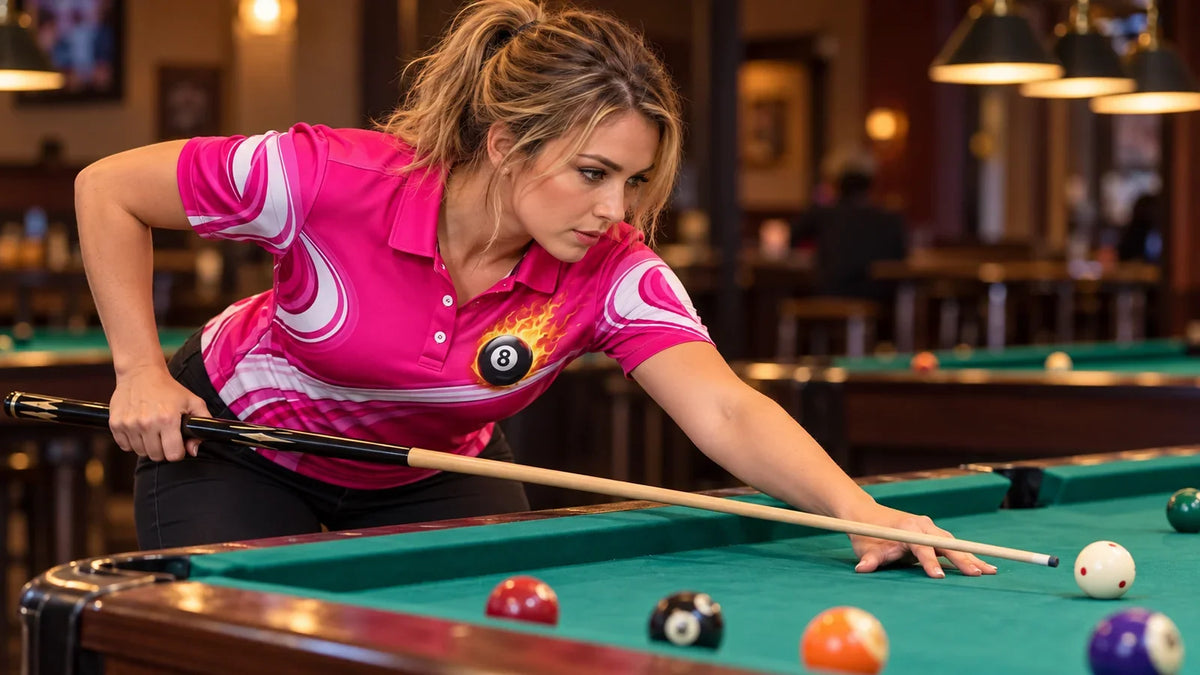
How to hold a pool cue? Hold the butt of the cue with your dominant hand near the back of the wrap, let it rest in your fingers (thumb and first two or three fingers), keep the grip loose and your forearm hanging straight down at contact. Your other hand forms a steady bridge on the table about 6 to 9 inches behind the cue ball.
This guide breaks the grip, the bridge and the stance into simple steps, then covers the most common mistakes. Playing league nights? See our pink billiard shirts for team jerseys with a bold look.
How to hold a pool cue step by step
1. Use your dominant hand on the butt
Right-handed players grip with the right hand, left-handed players with the left. FCI Billiards suggests you "place your hand near the center of the wrap area on the butt, with your palm roughly facing down." (FCI Billiards)
2. Let the cue rest in your fingers
Wrap your thumb around the side of the cue nearest your body and let the other fingers fall on the far side. The cue should sit in the fingers, not jammed into the palm. Many players use just the thumb, index and middle finger, with the ring and little finger barely touching.
3. Set light grip pressure
FCI calls this "the step most players get wrong." Their rule: firm enough that the cue won't slip, loose enough to slide it forward and back easily, like holding "a small bird." White knuckles mean you are squeezing too hard.
4. Hang your forearm straight down
At the moment the tip meets the cue ball, your grip-hand forearm should hang roughly vertical. If your hand is far forward or far back of that point, slide your grip along the wrap until it is.
5. Build a solid bridge
Plant your other hand on the cloth behind the cue ball. Keep the bridge 6 to 9 inches from the ball for most shots and shorten it for delicate shots or when you are near a rail.

Open bridge vs closed bridge
| Bridge | How to form it | Best for |
|---|---|---|
| Open (V) bridge | Hand flat, fingers spread, raise the knuckles and press the thumb against the index finger to make a V for the shaft | Beginners, soft and medium shots, clear view of the cue line |
| Closed (loop) bridge | Curl the index finger over the shaft into a loop, other fingers spread on the cloth | Power shots, breaks and draw shots where the shaft must not lift |
| Rail bridge | Lay the shaft on the rail and guide it with the thumb and index finger | Cue ball frozen or close to the cushion |
Start with the open bridge until your stroke is straight, then add the closed bridge for harder shots like the break shot in pool.
What is the best grip for a pool cue?
There is no single "best" grip, but good grips share three traits: they are relaxed, they put the forearm vertical at contact and they repeat the same way every shot. As FCI puts it, "a relaxed, consistent grip gives you accuracy, control, and comfort." A death grip tenses the shoulder, shortens the stroke and makes the cue tip wobble.

Stance: where your body goes
- Feet: about shoulder-width, back foot on the cue line, front foot turned slightly out.
- Head: low and still, chin over the cue, eyes level.
- Elbow: the grip-arm elbow stays still; the stroke swings from the elbow like a pendulum.
- Follow through: let the cue travel a few inches past where the cue ball was, then freeze.
Common mistakes when holding a pool cue
- Squeezing harder on power shots. Speed comes from a smooth arm, not a tight hand.
- Gripping too far forward, which bends the wrist and pushes the cue off line.
- A loose, wobbly bridge. Press the heel of the bridge hand into the cloth.
- Lifting the head on contact. Stay down until the ball stops rolling.
- Changing your grip shot to shot. Pick one hand position and repeat it.

How to hold a pool cue with small hands
Players with small hands often feel a thick wrap is hard to control. Keep the same light finger grip, use only the thumb and two fingers and do not try to close the hand fully. For the bridge, an open V bridge is easier to hold steady than a tight loop. If the cue still feels awkward, try a slimmer butt or a lighter cue at your local room before buying.
Drills to lock in your grip
- Stop-shot drill: shoot the cue ball straight into an object ball and try to stop the cue ball dead. A clean stop shows a straight stroke.
- Bottle drill: stroke through the neck of an empty bottle without touching the sides.
- Rail drill: shoot the cue ball up and down the table over the spots; it should come straight back to the tip.
Once your stroke feels steady, brush up on 8 ball pool rules and pool league etiquette before league night.

Want your whole team to stand out? Our pink billiard shirts come in polo and quarter-zip styles with a custom name or team name. Read what to wear to play pool for comfort tips.
FAQ
What is the proper way to hold a pool cue?
Hold the butt with your dominant hand in a loose finger grip, forearm hanging straight down at contact, and guide the shaft with a steady bridge 6 to 9 inches behind the cue ball.
What is the best grip for pool cues?
A relaxed grip in the fingers, firm enough that the cue will not slip but loose enough to slide, repeated the same way on every shot.
Should you hold a pool cue tight or loose?
Loose. A tight grip tenses the arm, shortens the stroke and pulls the cue off line.
How do you hold a pool cue with small hands?
Use the thumb and two fingers without closing the hand fully, and start with an open V bridge, which is easier to keep steady.
Billiards/Pool
 Personalized Black And Gold Tribal Dragon Billiard Shirt Custom 8 Ball Pool Team Jerseys$44.99
 Personalized Billiard 8 Ball & 9 Ball Pool Polo, 1/4 Zip Custom Team Billiard Jersey$44.99
 Personalized Billiard 8 Ball & 9 Ball Pool Polo, 1/4 Zip Custom Team Billiard Jerseys$44.99
 Personalized Purple 8 Ball Pool Wolf And Skull Billiard Shirt, Smoke Billiard Team Jerseys$44.99
More from the Journal

How to Hunt Elk: A Beginner Plan From Trailhead to Wallow
A beginner elk hunting plan: trailheads, wind, cow calling, ambush spots and common mistakes.
3 min read
How to Hunt Turkey: Gear, Setup, Calls and Tactics
Gear, a step-by-step spring morning plan, turkey calls, fall tactics and safety.
3 min read
How to Call Ducks: 8 Duck Calls and When to Use Them
The eight duck calls to learn, what they sound like, when to use them and common mistakes.
3 min read