

Spring Bird Migration: When It Peaks & How to See It

Every spring, billions of birds fly north across North America — warblers from Central America, orioles from the tropics, hummingbirds over the Gulf of Mexico. Most of them travel at night, and many pass right over our homes without us noticing. Learn a little about timing and weather, and spring migration becomes the most exciting birding season of the year.
When does spring migration peak?
Migration stretches from late winter to early June, with different groups moving at different times. Broadly, early birds are short-distance migrants that winter in the southern US; late birds are long-distance migrants coming from the tropics.
| Timing | Who's moving |
|---|---|
| February–March | Waterfowl, Red-winged Blackbirds, Killdeer, Sandhill Cranes, early robins and bluebirds |
| Late March–April | Tree Swallows, phoebes, kinglets, sparrows; first hummingbirds and warblers in the South |
| Late April–mid-May | Peak songbird migration for most of the US: warblers, orioles, tanagers, grosbeaks, thrushes |
| Late May–early June | Stragglers: flycatchers, cuckoos, Blackpoll Warblers, shorebirds heading to the Arctic |
Peak arrives earlier in the South and later in the North. In the Midwest and Northeast, the first two or three weeks of May are usually the best.

Why birds migrate at night
Most songbirds migrate in the dark. The air is calmer and cooler, predators like hawks are less active, and the stars help with navigation. They land at dawn to rest and refuel — which is why early morning, after a big night of migration, is the best time to go looking.
Use migration forecasts
Scientists now forecast migration much like weather. BirdCast uses weather radar to show how many birds are flying each night and predicts the coming nights. A few rules of thumb:
- Southerly winds in spring bring big flights north.
- A cold front or storm can force migrants to land en masse, creating a "fallout" — a once-a-season birding day.
- Clear nights after bad weather often release a pent-up wave.
Where to see migrants
- Local "migrant traps": green patches surrounded by development or water — city parks, cemeteries, riverside woods.
- Shorelines: birds often concentrate along the Gulf Coast and the Great Lakes before or after crossing water.
- Famous hotspots include High Island in Texas, Magee Marsh in Ohio, Point Pelee in Ontario and Central Park in New York City.
- Your own yard — especially with native trees leafing out, since migrants follow the insects.

Bring migrants to your yard
- Orioles: offer orange halves and a small dish of grape jelly in late April–May.
- Hummingbirds: hang a feeder a week or two before they're due (see our hummingbird guide).
- Water: a bird bath or dripper attracts warblers that never eat seed.
- Native trees: oaks and other natives in spring leaf are full of the caterpillars migrants need.
Help migrants on their journey
- Lights out: artificial light at night disorients migrants. Turn off unneeded outdoor lights and draw blinds, especially during peak weeks.
- Windows: make problem windows visible with exterior markers or screens.
- Cats indoors: tired migrants spend a lot of time on the ground.
Tools that make it easier
- Sound ID apps (like the free Merlin Bird ID) help you put names to dawn songs.
- eBird shows recent sightings near you and lets you add your own.
- Binoculars — 8x magnification is easiest for fast-moving warblers.
Warblers: the stars of May
For many birders, spring migration means warblers: small, active, brilliantly patterned songbirds, most of which spend the winter in Mexico, Central America, South America or the Caribbean. More than 30 species pass through parts of the eastern US each spring. They move fast and often feed high in trees, so a few tips help:
- Look for movement, then follow it with binoculars.
- Focus on field marks such as wing bars, eye rings, face pattern and tail spots.
- Learn songs gradually. Pick three common warblers in your area each year.
- Find sunny, sheltered spots on cool mornings, where insects become active first.
Keep a migration journal
Recording the date you first see each returning species is one of the most satisfying habits in birding. Over several years, you'll learn your local migration calendar and notice changes. Your records can also help science when you submit them to eBird.
| Species | First seen | Where | Notes |
|---|---|---|---|
| Ruby-throated Hummingbird | Male or female first? | ||
| Baltimore Oriole | |||
| Chimney Swift | |||
| Gray Catbird |
Use this simple template in a notebook or spreadsheet, and add species from your own area.
Why males often arrive first
In many songbirds, males return a few days to a week or more before females. Arriving early lets them claim the best territories. When the females arrive, they choose among the males and their territories, which is why early spring mornings are so full of song.
Celebrate the season
Hang a field-guide flag to welcome the birds back, or browse Shop by Bird.
 Ruby-throated Hummingbird Field Guide FlagShop now →
 Eastern Bluebird Field Guide FlagShop now →
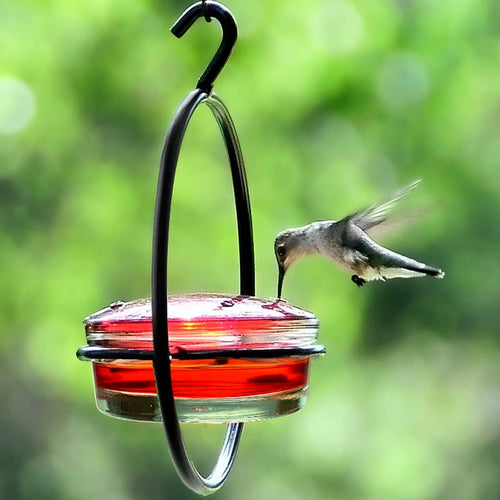
 Mason Jar Hummingbird Feeder, 6 oz GlassShop now →
A rough spring timeline
Timing shifts with latitude and weather, but in much of the eastern US the season unfolds roughly like this:
| When | Who's moving |
|---|---|
| Late February–March | Waterfowl, Red-winged Blackbirds, early robins and bluebirds |
| April | Swallows, kinglets, early warblers such as Yellow-rumped; hummingbirds in the South |
| Late April–May | Peak warbler, vireo, oriole and tanager movement; hummingbirds reach the North |
| Late May–early June | Late flycatchers and shorebirds heading to the Arctic |
FAQ
What birds are migrating right now?
Check BirdCast's live migration maps and recent eBird sightings for your county — they show what's on the move this week.
What time of day is best for seeing migrants?
Early morning, from sunrise until about mid-morning, when birds that flew overnight are actively feeding.
How far do migrating birds travel?
Some just a few hundred miles; others thousands. Many Ruby-throated Hummingbirds cross about 500 miles of open Gulf of Mexico in one flight.
Sources & further reading
More from the Journal
Winter Bird Feeding Tips: What to Feed & How to Help Birds
Long nights and short days make winter tough for small birds. The best foods, smart feeder setup, and hygiene habits that keep your winter flock healthy.
4 min read
Ruby-throated Hummingbird: Male vs. Female, Migration & Feeding
The only hummingbird that nests across most of the East weighs less than a nickel and crosses the Gulf of Mexico. Here's how to tell males from females — and when to...
4 min read
Native Plants for Birds: What to Plant for a Bird-Friendly Yard
Feeders help, but native plants feed birds all year — especially the caterpillars nestlings depend on. What to plant, what to avoid, and how to start small.
4 min read