

Ruby-throated Hummingbird: Male vs. Female, Migration & Feeding

For most people east of the Great Plains, "the hummingbird" means one species: the Ruby-throated Hummingbird. It is the only hummingbird that regularly nests across the eastern United States and Canada, and every spring it arrives after an astonishing journey. Here is how to tell the males from the females, what to expect through the season, and how to feed them safely.
Quick ID
- Size: about 3–3.5 inches long; weighs around 3 grams — less than a nickel.
- Color: bright emerald-green back and crown, grayish-white underparts.
- Bill: long, straight and needle-thin.
- Flight: hovers with a buzzing hum; wings beat roughly 50 times per second.

Male vs. female
| Field mark | Adult male | Female | Young male (late summer) |
|---|---|---|---|
| Throat | Iridescent ruby-red gorget (can look black in shade) | White or pale gray, sometimes faintly streaked | Pale with a few dark or red spots |
| Tail | Forked, all dark | Rounded, outer feathers tipped white | Rounded, white tips |
| Sides | Greenish-gray | Buffy-white | Buffy |
The male's throat feathers aren't red pigment the way a cardinal's are — they're iridescent, so the color depends on the angle of the light. A male can flash brilliant red one second and look completely black the next. If you see a "hummingbird with a black throat" in the East, it's often a male Ruby-throat in the shade.
In late summer, feeders fill with young birds that look like females. Young males may show a few scattered red sequins on the throat — a fun detail to look for.
Migration: an incredible commute
Ruby-throats spend the winter in southern Mexico and Central America. In spring, many of them cross the Gulf of Mexico in a single nonstop flight of roughly 500 miles, fattening up beforehand to fuel the trip. Others follow the coastline around the Gulf.
- Late February–March: first arrivals along the Gulf Coast.
- April: the Mid-South and Mid-Atlantic.
- May: the northern states and southern Canada.
- August–October: southbound migration; adult males leave first, young birds last.
Banding studies show that many hummingbirds return to the same areas — and even the same yards — year after year. That's why people swear "their" hummingbird comes back to the exact spot the feeder used to hang.

Nesting
Males don't help raise young. The female builds a walnut-sized cup of plant down bound with spider silk and camouflaged with lichen, usually saddled on a small branch. She lays two eggs the size of navy beans and raises the chicks alone.
Feeding them safely
- Recipe: 1 part plain white table sugar to 4 parts water. That's it.
- Skip: red dye, honey, brown sugar and artificial sweeteners.
- Clean: change nectar every 2–3 days (daily in hot weather) and scrub the feeder each time.
- Plant: native tubular flowers like trumpet honeysuckle, bee balm, cardinal flower and red columbine provide nectar and the tiny insects hummingbirds also need.
Want the full playbook? Read our guide on how to attract hummingbirds.
Behavior: small bird, big attitude
Ruby-throats are famously territorial. A male will claim a feeder or a patch of flowers and spend much of the day chasing away every other hummingbird, often with a dramatic, buzzing chase and a sharp chattering call. In spring, males also perform a courtship display: a wide, U-shaped "pendulum" dive in front of a perched female, swinging back and forth with a whirring sound from the wings.
Hummingbirds can hover, fly backward and even briefly fly upside down. To fuel that, they visit hundreds of flowers a day and eat small insects and spiders for protein, picking gnats from the air or stealing trapped insects from spider webs. On cold nights they can drop into torpor, a deep energy-saving state where their body temperature and heart rate fall sharply until morning.
Other hummingbirds you might see
East of the Mississippi, nearly every hummingbird in summer is a Ruby-throat. But a few others turn up:
- Rufous Hummingbird: a western species that increasingly appears in the Southeast in fall and winter. Males are bright orange-rufous; females show rusty sides and rufous at the base of the tail.
- Black-chinned Hummingbird: the Ruby-throat's western counterpart. Males have a black chin with a thin violet band below it, visible in good light.
- Anna's Hummingbird: a year-round resident on the Pacific Coast, with a rose-pink crown and throat in males.
A hummingbird at an eastern feeder in November or December is worth a careful look and a photo; local bird groups and banders are often eager to hear about it.
How long do they live?
Many hummingbirds live only a few years, but banding records show some Ruby-throats survive much longer, with documented birds reaching around nine years of age. Every one of those years means two long migrations, which makes each spring's arrival feel a little more remarkable.
Hummingbird favorites
Browse the Ruby-throated Hummingbird collection for feeders and field-guide gifts.
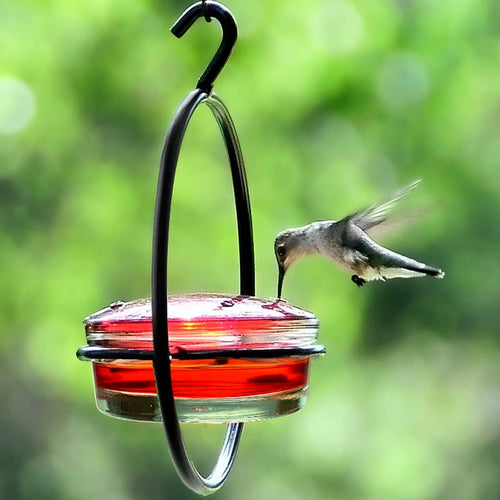
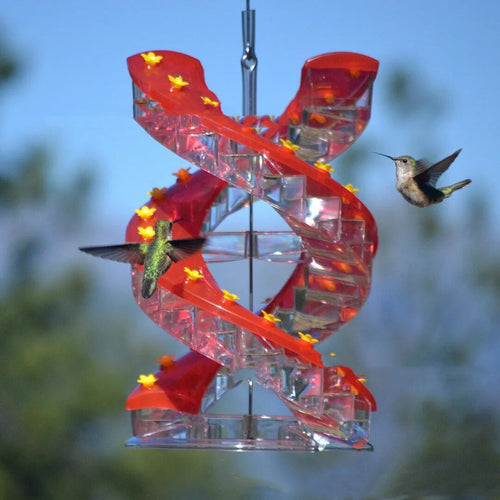
 Hand-Blown Glass Hummingbird Feeder, 33 oz with Perch RingShop now →
 Mason Jar Hummingbird Feeder, 6 oz GlassShop now →
 Ruby-throated Hummingbird Field Guide MugShop now →
 Ruby-throated Hummingbird Field Guide SuncatcherShop now →
FAQ
Is it rare to see a Ruby-throated Hummingbird?
Not in the East during spring and summer — they are common in gardens, woodland edges and at feeders. In winter they're essentially absent from the US except for rare stragglers along the Gulf Coast.
How do I tell a male from a female?
Adult males have a red (or black-looking) throat and a forked, all-dark tail. Females have a pale throat and a rounded tail with white corners.
Do they come back to the same place every year?
Often, yes. Banded birds have been recaptured at the same sites in later years.
Will leaving my feeder up in fall stop them from migrating?
No. Migration is triggered by day length and internal rhythms. Leaving a clean feeder up into fall can help late migrants refuel.
Sources & further reading


More from the Journal
Winter Bird Feeding Tips: What to Feed & How to Help Birds
Long nights and short days make winter tough for small birds. The best foods, smart feeder setup, and hygiene habits that keep your winter flock healthy.
4 min read
Spring Bird Migration: When It Peaks & How to See It
Billions of birds move north every spring, mostly at night. Here's when migration peaks where you live, how to read the forecasts, and how to catch the show.
4 min read
Native Plants for Birds: What to Plant for a Bird-Friendly Yard
Feeders help, but native plants feed birds all year — especially the caterpillars nestlings depend on. What to plant, what to avoid, and how to start small.
4 min read