

Eastern Bluebird: How to Identify & Attract Bluebirds
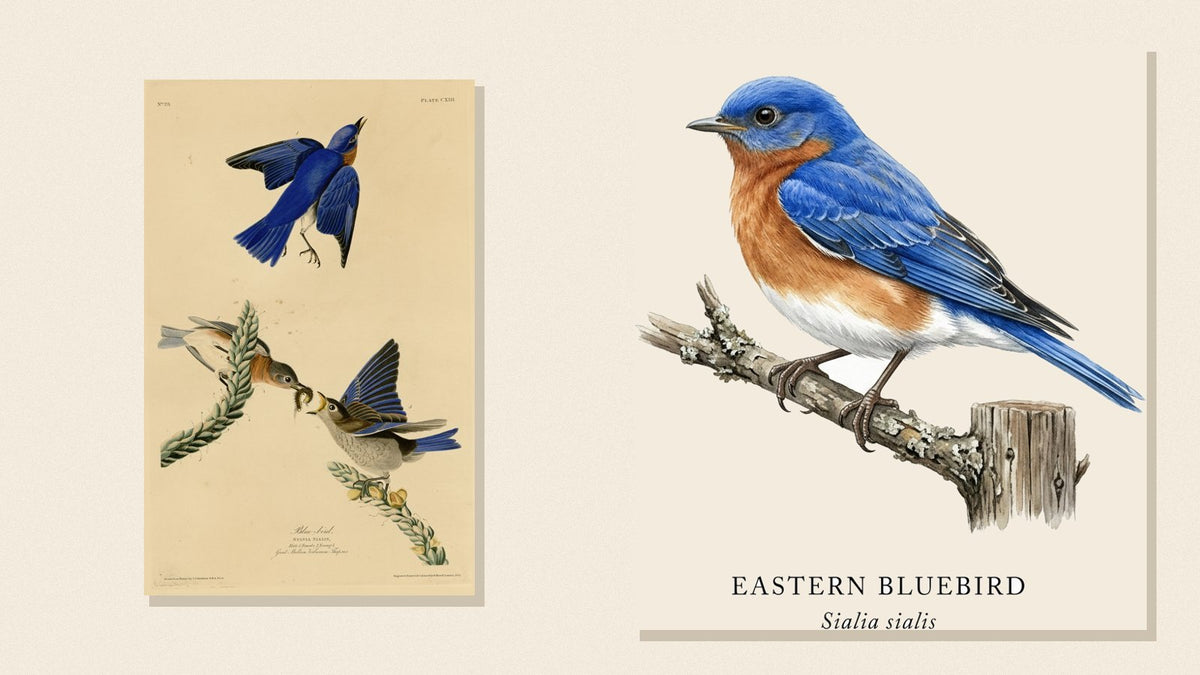
An Eastern Bluebird on a fence post is one of those sights that makes people stop the car. They're beloved, they're beautiful, and — after a hard century — they're a genuine conservation success story that ordinary backyard birders helped write. Here's how to identify them and how to give them a reason to stay.
Quick ID
- Size: about 6.5–8 inches; a small thrush, plumper than a sparrow.
- Male: vivid royal-blue head, back, wings and tail; rusty-orange throat and breast; white belly.
- Female: grayish head and back with blue in the wings and tail; paler orange breast; white eye-ring.
- Juvenile: gray-brown with a white-spotted back and speckled breast — the spots reveal it's a thrush, like a young robin — plus a hint of blue on the wings.
- Posture: sits upright on wires, posts and low branches in open country.

Where to look
Bluebirds like open ground with scattered perches: pastures, orchards, large lawns, parks, cemeteries, golf courses and the edges of fields. They sit on a perch, watch the ground, then drop down to snatch an insect. Dense forest and tightly built neighborhoods usually don't suit them.
They live year-round across much of the eastern and southern US. Northern birds move south for winter, often in small flocks, though more and more stick around wherever berries and open water hold out.
Song and calls
The song is a soft, low, warbling chur-lee, chur-chur-lee — gentle enough that you can miss it. Their call is a quiet, musical tu-a-wee, often given in flight.
What bluebirds eat
This is the key to attracting them: bluebirds mostly don't eat seed. In warm months they eat insects — grasshoppers, crickets, beetles and caterpillars. In fall and winter they switch largely to fruit: dogwood, sumac, holly, juniper, hackberry and wild grape.
| Season | Natural food | What to offer |
|---|---|---|
| Spring–summer | Insects | Live or dried mealworms in a shallow dish |
| Fall–winter | Berries and fruit | Native fruiting shrubs; suet nuggets; open water |

The nest box: your best bluebird magnet
Eastern Bluebirds nest in cavities. In the early 1900s they declined sharply as old wooden fence posts and dead trees disappeared and introduced House Sparrows and European Starlings took over nest sites. Volunteers responded with "bluebird trails" — lines of nest boxes along fields and roads — and the population rebounded. You can join in:
- Entrance hole: 1½ inches for Eastern Bluebirds (too small for starlings).
- Height: about 4–6 feet up, on a metal pole with a predator baffle.
- Location: facing an open area, ideally with a tree or perch within 50–100 feet for fledglings.
- Spacing: keep boxes at least 100 yards apart for bluebirds (pairing boxes closer together can let Tree Swallows take one and bluebirds the other).
- Monitoring: check weekly in season and remove House Sparrow nests promptly (House Sparrows are non-native and not protected).
Family life
In spring, a male bluebird shows off a potential nest site to a female by carrying nest material in and out of the box and perching on top with his wings fluttering. The female builds the nest, usually a neat cup of grasses or pine needles, and lays about three to seven pale blue eggs (occasionally white). Pairs in the South often raise two or even three broods a season, and young from an early brood sometimes help feed later siblings.
Fledglings leave the box at about two to three weeks old and are fed by their parents for a few more weeks. This is when the spotted juveniles appear on fences and low branches, often with a parent nearby carrying a caterpillar.
Bluebirds in winter
Bluebirds are hardier than they look. In winter they gather in small flocks and roam for berries and open water, sometimes roosting together in a single nest box to stay warm. You can help with:
- A heated bird bath, which may draw them more than any food.
- Native winter fruit such as winterberry holly, eastern red cedar, sumac and American holly.
- Mealworms or suet nuggets in a covered dish during cold snaps.
- Leaving nest boxes up all year as roosting shelters (clean out old nests after the season).
Eastern, Western or Mountain?
There are three bluebird species in North America. The Western Bluebird has a blue throat and often a rusty patch on the back. The Mountain Bluebird male is sky-blue all over with no orange. If you live east of the Great Plains, your bluebird is almost certainly an Eastern Bluebird.
Bluebird gifts
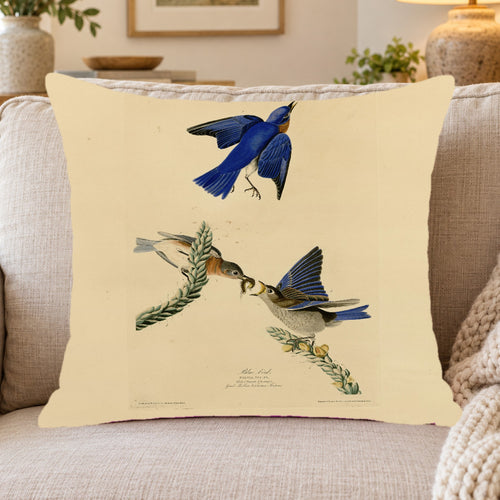
Love bluebirds? Our Eastern Bluebird collection includes field-guide canvases, suncatchers and flags.
 Eastern Bluebird Field Guide Canvas PrintShop now →
 Eastern Bluebird Field Guide SuncatcherShop now →
 Eastern Bluebird Field Guide FlagShop now →
 Metal Cottage Bird House Garden StakeShop now →
Note: the cottage bird house stake is a garden decoration; for nesting bluebirds, use a dedicated wooden nest box with the 1½-inch hole described above.
Bluebird nest box checklist
- Entrance hole of 1.5 inches (1 9/16 inch for Mountain and Western Bluebirds).
- Mount 4–6 feet high on a pole with a predator guard, facing an open field or lawn.
- No perch on the front — bluebirds don't need one and it helps House Sparrows.
- A side or front panel that opens for monitoring and cleaning; ventilation and drainage holes.
- Clean out old nests after each brood. Consider joining NestWatch to record what you see.
FAQ
Are Eastern Bluebirds rare?
No — they are common in the right habitat and their population has grown since the mid-1900s, thanks in large part to nest boxes.
What attracts bluebirds to your yard?
Open lawn or meadow, a nest box on a baffled pole, mealworms, native berry-producing shrubs and a bird bath.
Do Eastern Bluebirds live in Canada?
Yes, they breed in southern Canada (especially southern Ontario and Quebec) and migrate south for winter.
What do baby bluebirds look like?
Spotted gray-brown with just a little blue in the wings and tail — quite different from their parents.
Sources & further reading
More from the Journal
Winter Bird Feeding Tips: What to Feed & How to Help Birds
Long nights and short days make winter tough for small birds. The best foods, smart feeder setup, and hygiene habits that keep your winter flock healthy.
4 min read
Spring Bird Migration: When It Peaks & How to See It
Billions of birds move north every spring, mostly at night. Here's when migration peaks where you live, how to read the forecasts, and how to catch the show.
4 min read
Ruby-throated Hummingbird: Male vs. Female, Migration & Feeding
The only hummingbird that nests across most of the East weighs less than a nickel and crosses the Gulf of Mexico. Here's how to tell males from females — and when to...
4 min read