

Great Blue Heron: Identification, Behavior & Where to See Them

Stand by almost any pond, river or marsh in North America long enough and you'll likely see one: a tall, gray-blue bird frozen at the water's edge, then striking so fast you barely see the fish disappear. The Great Blue Heron is the largest heron on the continent and one of the most widespread wading birds. Here's how to identify it and understand what it's doing.
Quick ID
- Size: very tall — about 3–4½ feet, with a wingspan of up to about 6½ feet — yet it typically weighs only around 5–6 pounds.
- Color: blue-gray body; whitish face with a black stripe above the eye that ends in black plumes.
- Bill: long, thick, dagger-like and yellowish.
- Neck and legs: long S-curved neck and long legs; rusty "thighs."
- Voice: a deep, hoarse croak — frahnk — often given when flushed.

Heron or crane? The neck trick
People often call Great Blue Herons "cranes," and in flight the two can look similar. The easiest way to tell them apart:
| Feature | Great Blue Heron | Sandhill Crane |
|---|---|---|
| Neck in flight | Folded back in an S, head tucked | Stretched straight out |
| Wingbeat | Slow, deep, bowed wings | Smooth, with a quick upstroke |
| Color | Blue-gray; black plumes | Gray (often rust-stained) with a red crown |
| Voice | Hoarse croak | Rolling, bugling rattle |
| Social | Usually hunts alone | Often in pairs, families or flocks |
How herons hunt
Great Blue Herons are masters of patience. They wade slowly or stand perfectly still in shallow water, then spear or grab prey with a sudden thrust of the neck. Fish make up most of the diet, but they also take frogs, crayfish, snakes, insects, rodents and occasionally small birds — a heron hunting voles in a hayfield is a common sight. Special vertebrae in the neck allow that lightning-fast strike.

Heronries: nesting together
Although they hunt alone, Great Blue Herons usually nest in colonies called heronries or rookeries — sometimes a handful of nests, sometimes hundreds — high in trees, often on islands or in swamps where predators struggle to reach them. Pairs build bulky stick platforms and raise about 2–6 young. Colonies are sensitive to disturbance during nesting, so view them from a distance.
Where and when to see them
- Year-round across much of the US, wherever water stays open.
- Northern birds move south in fall, though some linger as long as they can find unfrozen water.
- In south Florida and the Keys, an all-white form — the "Great White Heron" — occurs. It's larger than the Great Egret and has yellowish legs.
Herons and backyard ponds
If a heron is visiting your koi pond, you're not alone. Netting, deeper areas or underwater shelters where fish can hide, and steep pond edges make fishing harder. Great Blue Herons are protected under the Migratory Bird Treaty Act, so stick to humane deterrents.
Other herons and egrets
| Bird | Size vs. Great Blue | Key marks |
|---|---|---|
| Great Egret | Slightly smaller | All white, yellow bill, black legs |
| Little Blue Heron | Much smaller | Dark slate-blue adult, two-toned bill |
| Tricolored Heron | Much smaller | Slender; blue-gray with white belly |
| Green Heron | Crow-sized | Compact, chestnut neck, often hunched |
| Black-crowned Night-Heron | Stocky, smaller | Black cap and back, red eye; active at dusk |
Powder down and preening
Herons have special patches of "powder down" feathers that crumble into a fine powder. Herons rub this powder into their plumage with their bills, then comb it out using a serrated claw on the middle toe, which helps remove fish slime and oils. It's one reason a bird that spends its life in muddy water still looks so neat.
Herons in winter
Great Blue Herons are surprisingly tough. Many stay as far north as open water allows, hunting at springs, rivers below dams, and the edges of fast-flowing streams. When ponds freeze, they'll also hunt rodents in fields. On cold days they may stand on one leg with the other tucked into their feathers and the neck pulled down, conserving warmth.
Tips for watching herons
- Approach slowly and stop often; a flushed heron loses hunting time.
- Watch the neck: a slowly lowering, coiled neck often means a strike is coming.
- Early morning and evening are the most active feeding times.
Heron gifts
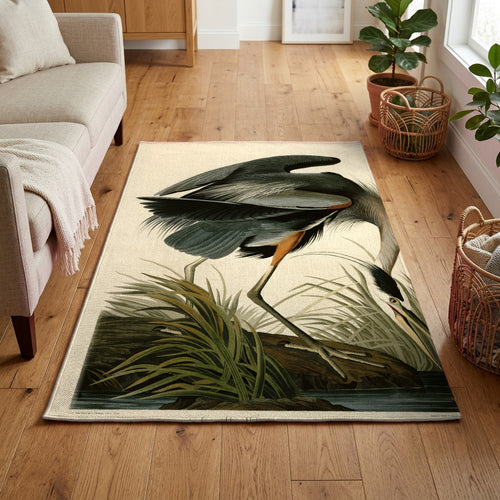
The stately heron looks right at home on a lake-house wall. Explore the Great Blue Heron collection.
 Great Blue Heron Field Guide Canvas PrintShop now →
 Great Blue Heron Field Guide MugShop now →
 Great Blue Heron Field Guide SuncatcherShop now →
 Great Blue Heron Field Guide FlagShop now →
Field marks checklist
- Size: the largest heron in North America, roughly 3.5–4.5 feet tall with a wingspan near 6 feet.
- Color: blue-gray body, white face with a black stripe above the eye, and a thick, dagger-like yellowish bill.
- Flight: slow, deep wingbeats with the neck folded into an S and legs trailing behind.
- Voice: a harsh, croaking "frahnk," often given when the bird is startled.
- White form: in south Florida, an all-white "Great White Heron" form occurs; it is larger than a Great Egret and has paler legs.
FAQ
Are Great Blue Herons rare?
No — they're common and widespread across North America.
Why does a heron stand still for so long?
It's hunting. Staying motionless lets fish come within striking range without noticing.
Do Great Blue Herons migrate?
Partly. Many in the South stay all year; northern birds move south as water freezes.
How can such a big bird weigh so little?
Like other birds, herons have hollow, air-filled bones, and much of their size is legs, neck and feathers.
Sources & further reading



More from the Journal
Winter Bird Feeding Tips: What to Feed & How to Help Birds
Long nights and short days make winter tough for small birds. The best foods, smart feeder setup, and hygiene habits that keep your winter flock healthy.
4 min read
Spring Bird Migration: When It Peaks & How to See It
Billions of birds move north every spring, mostly at night. Here's when migration peaks where you live, how to read the forecasts, and how to catch the show.
4 min read
Ruby-throated Hummingbird: Male vs. Female, Migration & Feeding
The only hummingbird that nests across most of the East weighs less than a nickel and crosses the Gulf of Mexico. Here's how to tell males from females — and when to...
4 min read