

Common Loon Calls: The Wail, Yodel & Tremolo Explained
For many people, the sound of summer isn't a song at all — it's a long, rising wail across a dark lake. The Common Loon has one of the most recognizable voices in nature, but what most people call "the loon call" is really a vocabulary of four distinct sounds. Here's what each one means, plus how to identify loons through the year.
The four loon calls
| Call | What it sounds like | What it means |
|---|---|---|
| Wail | A long, rising, mournful ooo-AAH-ooo, like a wolf howl | "Where are you?" — used to keep in contact with a mate or chick |
| Tremolo | A quavering, laughing ha-ha-ha-ha | Alarm or agitation; the only call loons give in flight |
| Yodel | A long, rising, repeated yodeling phrase | Given only by males, defending territory |
| Hoot | A soft, short hoo | Quiet contact between family members |
Each male's yodel is individually distinctive — researchers can recognize particular birds by it. If you hear lots of tremolos and yodels near a boat or swimmers, the loons are stressed; that's your cue to give them more room.

How to identify a Common Loon
Breeding (summer) plumage
- Large and long-bodied: about 26–36 inches, sitting low in the water.
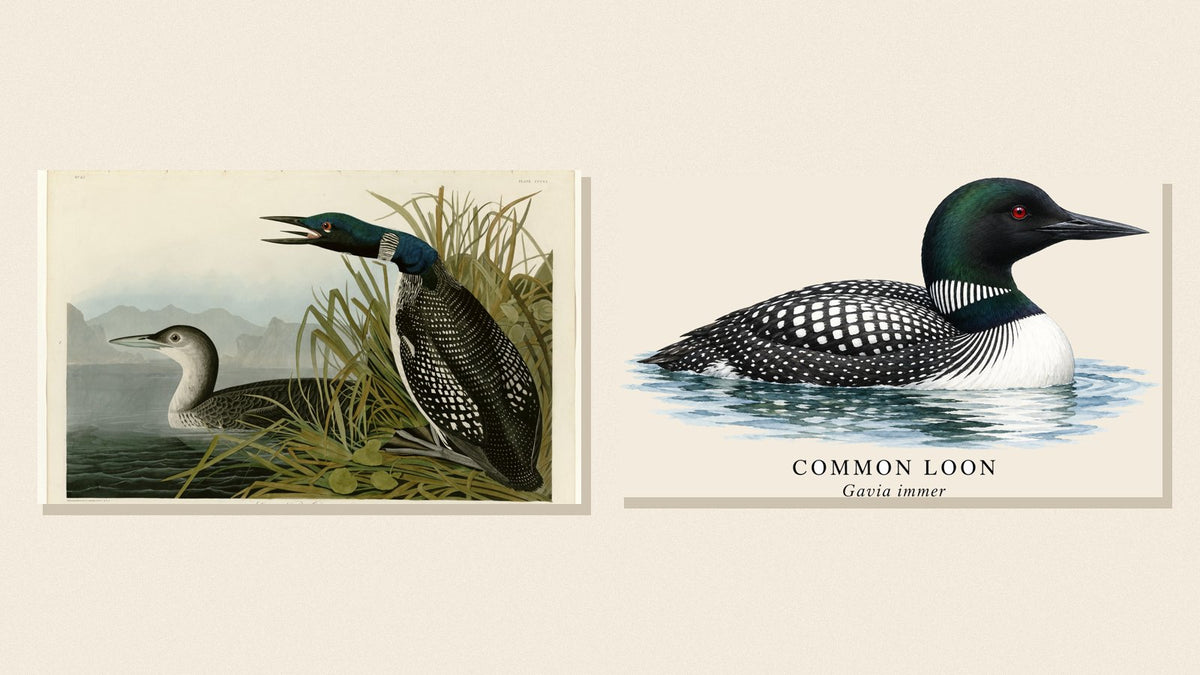
- Glossy black head with a greenish sheen and a deep red eye.
- Black-and-white striped "necklace" and a checkerboard back of white spots.
- Heavy, dagger-shaped black bill.
Winter plumage
- Plain gray-brown above, white below, with a jagged border on the neck.
- Paler, gray bill — held level, not tilted up like the smaller Red-throated Loon.
Built to dive
Loons are superb divers. Unlike most birds, their bones are dense rather than hollow, which helps them sink. Their legs sit far back on the body — perfect for underwater propulsion, terrible for walking. That's why loons only come ashore to nest, right at the water's edge, and why they need a long running start across the water to get airborne. A small pond can be a trap; loons prefer large, clear lakes with plenty of runway and fish.

Where and when to see loons
- Summer (May–August): northern lakes of Canada and Alaska, and in the US mainly Minnesota, Wisconsin, Michigan, northern New York, and northern New England.
- Migration (spring and fall): large lakes and reservoirs across the interior; the Great Lakes.
- Winter: along the Atlantic, Pacific and Gulf coasts.
Loon chicks often ride on their parents' backs for their first couple of weeks — one of the best sights on a quiet morning paddle.
Enjoy loons respectfully
- Stay well back from nests and families, and use binoculars instead of approaching.
- Slow down and give wide berth in boats; wakes can swamp nests at the shoreline.
- Use lead-free fishing tackle — swallowed lead sinkers and jigs are a known cause of loon deaths.
- Pack out fishing line.
Raising loon chicks
Loons nest right at the water's edge, often on small islands, muskrat lodges or floating vegetation, where they can slide straight into the water. Both parents incubate, usually two olive-brown eggs, for about four weeks. The chicks can swim almost immediately but tire quickly and get cold, which is why they ride on a parent's back during their first couple of weeks. Parents feed them small fish and aquatic insects for weeks, and young loons don't fly until they're around 11 to 12 weeks old.
Adults typically leave their breeding lakes before the young do. Juveniles gather on larger lakes, then find their own way to the coast for the winter, without a guide.
How deep can loons dive?
Loons regularly dive to catch fish in water tens of feet deep and can stay under for about a minute, sometimes longer. Watching a loon dive is a classic lake game: guess where it will surface. You'll usually be wrong. They catch fish with their bills and swallow most of them underwater.
Other loons
- Red-throated Loon: smaller and slimmer, with a thin bill often held tilted upward. Breeding adults have a gray head and dark red throat patch.
- Pacific Loon: mid-sized, with a smooth, rounded gray head in summer. Common off the West Coast in winter.
- Yellow-billed Loon: a large Arctic loon with a pale, upturned bill; rare south of Alaska.
Photographing loons responsibly
Use a long lens, stay low and quiet, and let the loons approach you rather than chasing them. A loon that repeatedly calls, rises up and "penguin dances" upright on the water is very stressed; back away immediately.
Cabin-ready loon gifts
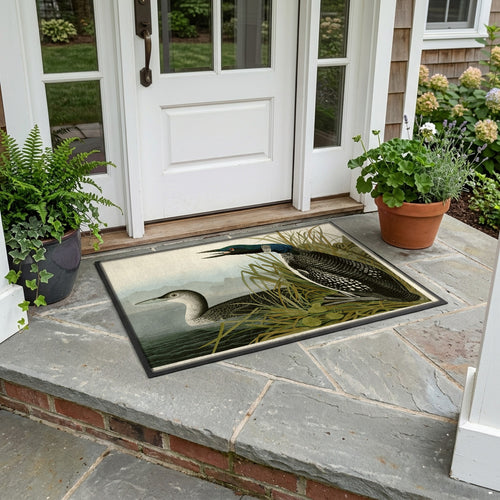
Bring the lake home with our Common Loon collection.
 Common Loon Field Guide MugShop now →
 Common Loon Field Guide Sherpa BlanketShop now →
 Common Loon Field Guide FlagShop now →
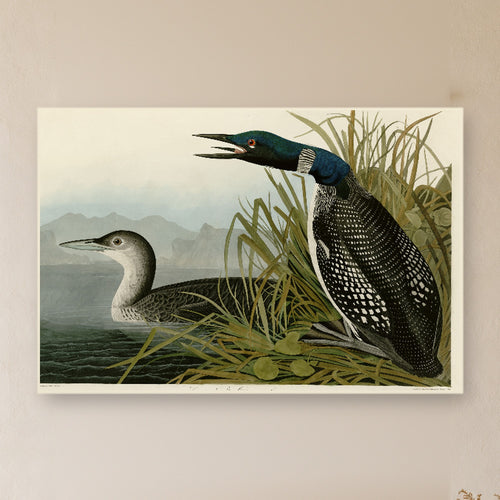
 Common Loon Field Guide Canvas PrintShop now →
Tips for hearing loons
- Listen at dusk, after dark and at dawn on northern lakes in late spring and summer — calling is often most active then.
- Calm, still nights carry sound across the water for long distances.
- Keep a respectful distance; a loon that calls the tremolo at you repeatedly may be stressed.
- Learn the wail first: it's the long, rising call most people picture when they think of loons.
FAQ
Why do loons call at night?
Wails and yodels carry far over calm night water, making it a good time for mates to keep in touch and males to advertise territory.
Is the loon Minnesota's state bird?
Yes — and the Common Loon is also featured on Canada's one-dollar coin, nicknamed the "loonie."
Can loons walk?
Barely. Their legs are set so far back that they shuffle awkwardly on land, which is why nests are placed right at the water's edge.
Do loons mate for life?
Not exactly. Pairs often reunite on the same territory, but studies show partners change more often than once believed.
Sources & further reading


More from the Journal

Winter Bird Feeding Tips: What to Feed & How to Help Birds
Long nights and short days make winter tough for small birds. The best foods, smart feeder setup, and hygiene habits that keep your winter flock healthy.
4 min read
Spring Bird Migration: When It Peaks & How to See It
Billions of birds move north every spring, mostly at night. Here's when migration peaks where you live, how to read the forecasts, and how to catch the show.
4 min read
Ruby-throated Hummingbird: Male vs. Female, Migration & Feeding
The only hummingbird that nests across most of the East weighs less than a nickel and crosses the Gulf of Mexico. Here's how to tell males from females — and when to...
4 min read